Photographs and printed matter
History in pictures.
Faces, places, letterheads and advertisements. Take time to look at what the images pass on to us.
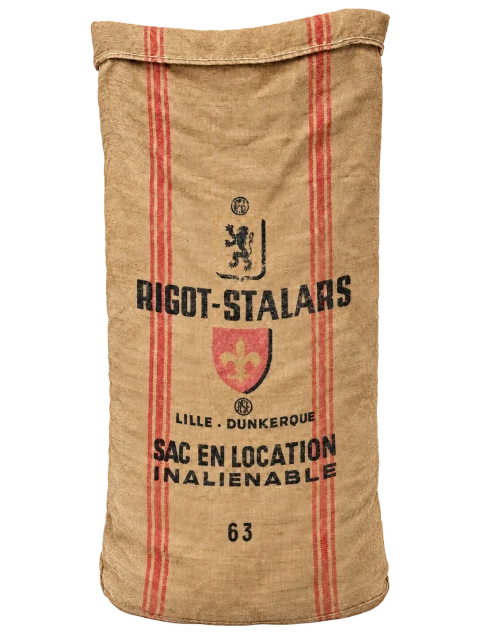
Faces, workshops, places and printed material tell the firm's story together. Open a photograph, compare two letterheads, pause over an advertisement: each image opens a door onto an era.
Album 01
The firm at work
Cloth unfolds and sacks pass from hand to hand. Their next life is prepared in the workshops.
Browse the 23 other photographs
Album 02
Establishments and their towns
Behind each facade, a team, goods and a place in the network.
Browse the 17 other photographs
Album 03
The faces behind the firm
Family members and employees appear in portraits and group photographs.
Browse the 13 other photographs
Album 04
Jean Rigot and new forms of packaging
From buildings to encounters, the images accompany another era of industrial life.
Browse the 19 other photographs
Album 05
The 1970s
Colour enters the albums. Around the tables, family ties meet working relationships.
Browse the other 9 photographs
Album 06 · The firm's identity
The firm's name, shaped by time.
Before a letter was even read, its stationery identified the firm. Names, lettering, façades and medals spoke of its trades and place in commerce. These small printed fragments reveal another history of Rigot-Stalars.
From a printed name to an illustrated identity
On the 1875 letterhead, a few lines were enough to announce the wine and spirits trade. In illustrated designs, the façade became an emblem and awards took their place around the firm's name. Papers devoted to cloth, sacks and tarpaulins carried the family name in turn.
Wines and spirits: the name Rigot-Stalars already stands out in large letters on this letterhead used in June 1875.
Façades, medals and ornate lettering form a commercial portrait. The paper is undated; it mentions the Lille exhibition of 1902.
Another illustrated design puts textile activities first, bringing the trades together under the name Rigot-Stalars.
1926: one name, several styles of lettering
The establishments in Lille, Dunkerque, Rouen, Paris and Marseille all bear the name Rigot-Stalars. Yet their stationery retains different identities: a small cursive signature, a broad commercial heading, capital letters or an overprint. Viewed side by side, they reveal each address's personality.
Explore the six establishments' signatures in 1926
The name resembles a signature drawn with a pen. The branch uses a compact letterhead in the corner of the page.
Activities and address frame the firm's name: a local expression of the family identity.
Cursive lettering stretches across the width, accompanied by specialities in sacks and tarpaulins.
The Paris establishment combines its address with the large, sloping letters of Rigot-Stalars.
Rigot-Stalars Fils appears overprinted on the name M. Reynaud. This overlap is part of the original printed document.
The stationery used in Lille in December 1926 favours capital letters and a more structured presentation of activities.
Lettering grows simpler; memory remains
Elaborate decoration gives way to more restrained lettering and the company's specialities. Its origins remain present: the founding date or centenary emblem accompanies the firm's name.
The 1826–1926 cartouche preserves the memory of the firm's hundredth anniversary. It does not, on its own, establish when this paper was printed.
Jute spinning and weaving, sacks and tarpaulins: the specialities accompany a name set in serif capitals.
See the two Dunkerque letterheads used in 1946
Compact typography brings the firm's name and activities together in a narrow band.
Large upright letters give full prominence to the name Rigot-Stalars Fils.
From the three initials RSV to today's RS
With Rigot-Stalars & Vandesmet, the initials intertwine. This historical monogram inspired the RS emblem created for this website, extending the firm's memory to the browser-tab icon.
This name appears on the firm's stationery alongside the RSV monogram, also found in the 1975 documents.
Three initials intertwine into one emblem. Detail from a letterhead dated 1979.
A contemporary adaptation inspired by the historical RSV now accompanies the family's memories.
Album 07 · Making the firm known
When Rigot-Stalars advertised.
An illustrated bottle, a promise for harvest time, a machine preparing fruit for sale: every advertisement addresses a trade and a need. From commercial prints to newspaper columns, these advertisements show how the firm presented its products and services.
The first part of the same commercial print: the address, building and awards introduce the firm.
The second part of the print: the bottle and its label take centre stage to promote the product.
Sacks and tarpaulins, for sale and hire: the Dunkerque advertisement addresses farming customers and publicises its stockists.
The Packmatic advertisement shows fruit and vegetables being bagged. Rigot-Stalars appears as the general agent in Lille and Paris.
Discover three other commercial ads, from 1920 to 1961
In Rouen, a short advertisement offers used sacks in good condition for various uses.
In Saint-Brieuc, hemp cloths are offered for conventional and hydraulic presses.
A trade presentation of the Saint-Brieuc establishment lists sacks, tarpaulins, blinds, yarns, twine and sailmaking.
Album 08 · Daily life in the press
Behind the advertisements, the trades.
Classified advertisements reveal what a photograph does not always show: work done at home, sack repairs, handling goods and maintaining machines. Alongside commercial advertising, they give voice to the firm's everyday life.
Open the six classified advertisements, 1923–1930
A Dunkerque advertisement offers work unpicking sacks at home: a few lines reveal one of the sack trade's less visible tasks.
The firm offers premises in Dunkerque. An ornamental border makes this small advertisement stand out on the newspaper page.
Recruitment for a driver combines operating a three-tonne lorry with machine maintenance.
An advertisement seeks workers to repair sacks by machine at the rue du Magasin Général address in Dunkerque.
On rue du Jeu de Mail, the firm seeks women able to repair sacks by hand using a sailmaker's palm, and women for machine repairs.
Mechanics and handling staff are wanted at both addresses: the workshops need several trades.
Album 09 · Celebrating the firm
Even music marks the centenary.
In 1926, the hundredth-anniversary celebration also takes the form of sheet music. Another printed object preserves the Rigot-Stalars name in the memories of those who shared the firm's life.