One object, a whole history
The sack that
carried
goods on their journeys.
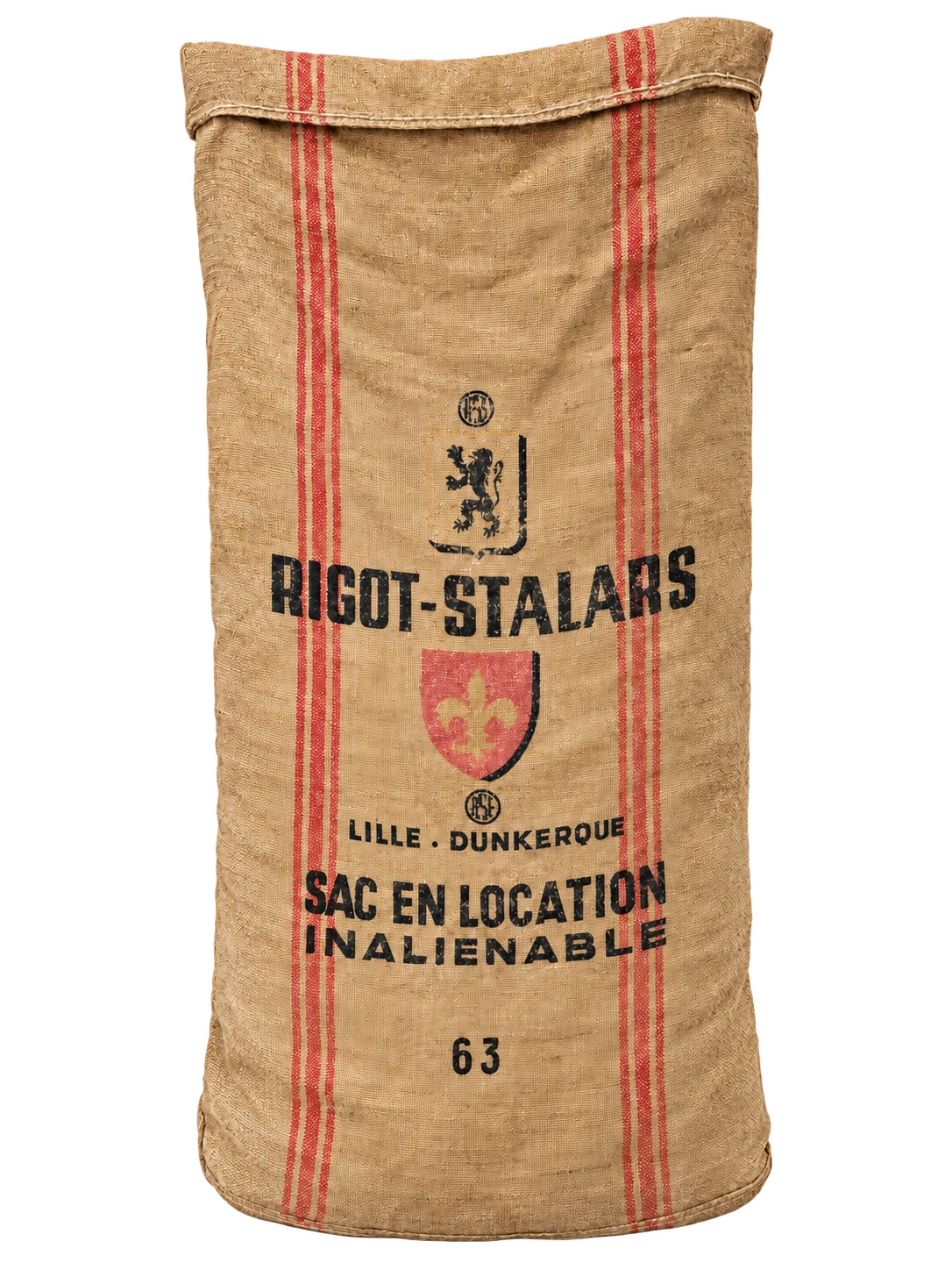
Golden cloth, two red stripes, the firm's name. This jute sack holds an essential part of the Rigot-Stalars story.
It was made to serve, travel and return. Its story brings together the crops of Bengal, the textile trades, the needs of commerce and the work of several generations.
01 · Before the sack, a plant
The journey begins in Bengal.
Long before it enters a warehouse in Lille, jute grows in a landscape of heat and water. Its historic heartland is Bengal, in the territories now belonging to India and Bangladesh. This annual plant produces long stems from which a plant fibre is extracted. It is not the woody stem that is spun, but the fibres beneath its bark.
Harvesting is followed by retting. Bundles of stems are submerged in water, allowing the fibres to separate from the other plant tissues. They must then be extracted, washed and dried. Sorted by quality, they are compressed into bales for transport. The sack therefore begins with a succession of agricultural tasks, far from the machines that will give it its shape.
In the nineteenth century, mechanisation transformed the markets for this material. Dundee, in Scotland, became a major centre of the jute industry; spinning and weaving mills also developed in Bengal. Maritime trade connected the cultivation of the plant with European markets. Within the British Empire, this industry depended as much on the work of growers and mill workers as on merchants and shipowners.
The resulting cloth met an immense need: to hold the goods that agriculture and industry sent into circulation. Strong and relatively inexpensive, it could be folded, sewn and marked. It could also be used again. At a time when much merchandise was handled in sacks, these qualities gave it an everyday role in mills, warehouses, railway stations and ports.
A working material
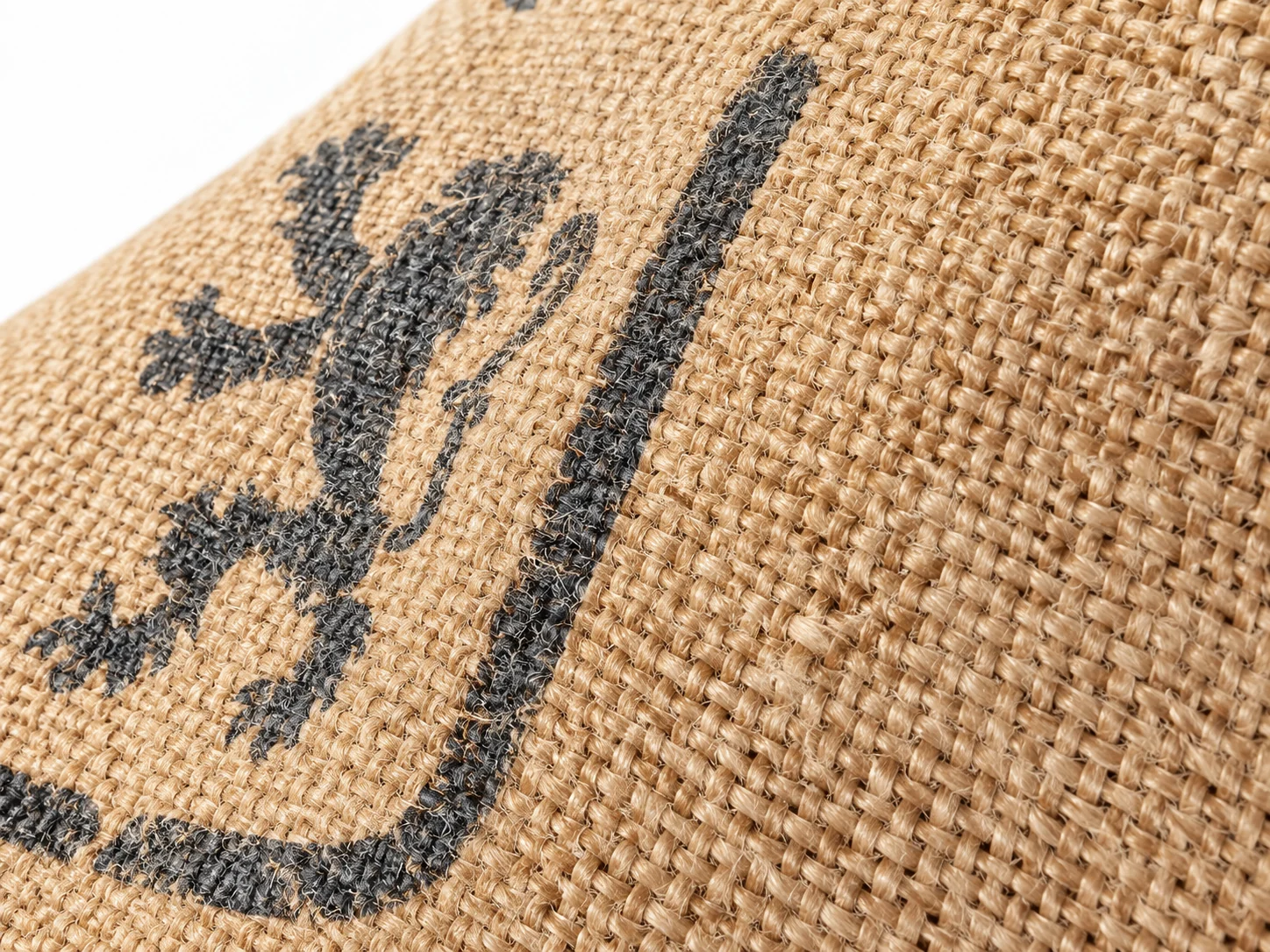
The strength of a simple cloth.
Warp threads cross weft threads. Their interlacing creates cloth: a flexible surface that sewing turns into a container.
Jute cannot protect every product on its own. What is being transported matters. For certain uses, a lining provides extra protection: this search for practical adaptations would accompany the firm's transformation.
02 · Lille: trade, then workshops
The sack enters the Rigot story.
In 1826, Prosper Nicolas Rigot and Sophie Godart opened the first chapter of the family story in Lille. This was not yet a great jute spinning mill: the firm began in trade, particularly in beverages. Its activities shifted and expanded over the generations.
Prosper François Rigot took over in 1843. Together with Justine Henriette Stalars, he gave the firm its enduring name. Trade in sacks, cloth and packaging grew in importance. Justine played a part in this business; when her husband fell ill, she and their sons kept it going.
For a long time, the business involved much more than supplying new sacks. Buying and selling used sacks, repairing them, keeping cloth in stock and meeting customers' needs: the firm's value also lay in its understanding of practical uses and its ability to keep packaging in circulation. Under Paul, Prosper Charles and Eugène, the network expanded. Lille and Dunkerque became two bases for a business looking far beyond northern France.
This early history explains what followed. Before integrating spinning and weaving, the Rigot family already knew the sack through its markets. They understood what it had to hold, how it travelled and why it needed to be recovered. Industrial manufacturing would build on that trading experience.
03 · Packaging designed to return
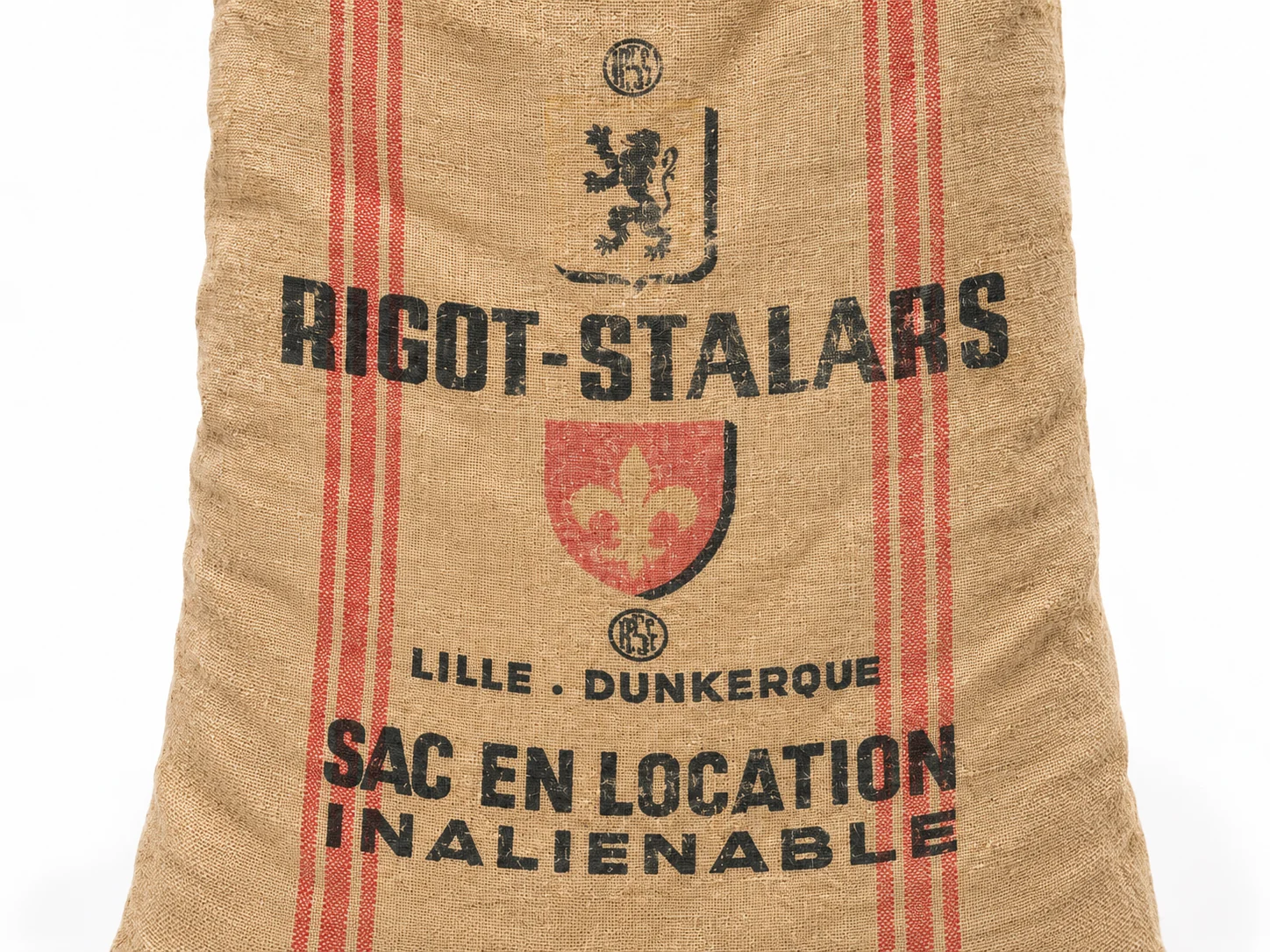
“Sack for hire. Not to be sold.”
These words printed on the cloth tell the story of an entire trade.
The sack accompanies the goods, but remains the property of the firm that hires it out. The word “inaliénable” makes clear that the user cannot sell it as their own. The marking identifies its owner among packaging that passes from hand to hand.
The journey therefore does not end with unloading. The empty sacks must be collected, brought together, sorted and repaired wherever they can still be used. Repair workshops and the second-hand trade are integral to this economy of reuse.
1919 · From the Aude to Paris: the return journey.
On 14 October 1919, the Aude department entered into a contract with Barrière, a merchant in Carcassonne, to collect empty sacks. They were stored in Toulouse, then sent to Rigot, Stalars et Cie in Paris, the firm that hired them out.
This supply network brings the sack's inscription to life: behind the cloth are depots, carriers, accounts to keep and an organisation capable of arranging its return.
- Supply
- Transport
- Collect
- Repair
- Reuse
A name printed to be recognised
The brand travels with the cloth.
Red stripes, motifs and black lettering give this sack an immediately recognisable identity. “Lille · Dunkerque” recalls the two establishments associated with its name.
The printing serves a practical as well as a commercial purpose. It distinguishes the container, identifies its owner and makes the firm known on every journey. The sack becomes an everyday bearer of the brand, far beyond the firm's buildings and letterheads.
The number “63” also appears on the surviving sack. Its meaning has not been established, so it is not interpreted here as a date.
Feeding, supplying, producing
What the sacks carried.
Potatoes, grain, seeds, beans, livestock feed, flour and sugar: the firm's sacks first served a whole agricultural and food economy. Yet the same word, “sack”, covered very different needs. Products of varying shapes, weights and fineness had to be contained, and the sacks had to withstand handling.
The business also supplied packaging for fertilisers, potash, slag, salt, soda, sulphur and other chemicals or coal-derived products. Packaging connected farms, flour mills and industries. Its usefulness lay in the diversity of goods that could not have circulated in the same way without it.
Alongside sacks, the firm also traded and worked with cloth. Jute has other uses: packaging, filtration, backing for coverings or carpets, twine and rope. These applications illustrate the fibre's versatility; they do not mean that every finished product was made in the Rigot-Stalars workshops.
04 · The First World War
When the sack also offered protection.
During the war of 1914–1918, cloth found another use: filled with earth, sacks helped build and protect soldiers' positions. At 11 rue du Jeu-de-Mail in Dunkerque, an appeal for hand-sewn sandbags announced the reopening of the workshop for the Ministry of War.
The work involved remaking used sacks supplied by the ministry. In a time of shortage, material already available was put back into service. Reusing the cloth saved the cost of new fabric and reduced the need for imports.
Women were invited to take part in this sewing work. They could work at home or in the workshop, advertised as heated and lit. Piece rates rose from four to five centimes. Behind the patriotic appeal was practical, repetitive labour, paid by the number of sacks made, amid everyday lives disrupted by war.
The sack then connected several worlds: workshops behind the lines, supply services and frontline positions. It carried food; it also provided protection. The firm's wartime history can be read in these adaptations, as well as in the lives of its family members and employees.
05 · Becoming a manufacturer
From trading to a complete production chain.
The industrial transformation took shape after the centenary in 1926. In 1928, the firm took over the Dickson weaving mill in Marquette. In 1933, it acquired a spinning mill in Fives-Lille. It thus gained control over more of the product: its knowledge of sacks sold and hired out was extended to the processing of fibre, yarn and cloth.
The Second World War devastated these facilities. In 1944, the Fives spinning mill was bombed several times; the weaving mill was also destroyed. An accidental fire struck the facilities again in 1947. Reconstruction brought spinning and weaving together in Marquette at the end of 1948.
In the post-war decades, the firm described itself as supplying around eight million sacks a year, including four million lined sacks. This historical figure, preserved without a precise year, gives a sense of the scale it had reached. Behind this activity stood workshops, maintenance departments, offices and establishments handling sales and second-hand sacks.
Inside the workshops
Five stages in shaping the fibre.
- 01
Open and prepare.
Bales of jute are opened, and the fibres softened and divided into handfuls. A spreader forms an initial sliver. An emulsion of oil and water, known as batching oil, helps the fibres slide past one another; a resting period allows it to penetrate.
- 02
Card, draw, spin.
Carding and drawing make the sliver more even. The fibres gradually align before passing through the spinning machines. The resulting yarn is prepared for use as warp or weft.
- 03
Weave the cloth.
Warping prepares the warp threads. Sizing helps them withstand the operations that follow. Weaving interlaces the threads; the firm uses both flat and circular looms.
- 04
Cut, sew, print.
Sewing turns the cloth into sacks. Hemming, overlocking and seam-folding machines perform the assembly and finishing work. Markings can be printed in one, two, three or four colours, bringing the customer's intended use and identity onto the fabric.
- 05
Add the lining and prepare for dispatch.
Some jute sacks receive an inner polyethylene bag, cut and heat-sealed in a separate workshop. This operation, known as ensachage, combines two materials. The sacks are then grouped together for delivery.
A firm built on skills and places.
Marquette relies on spinning, weaving and sewing teams, as well as mechanics, carpenters, electricians and handling staff. Continuous production depends on this work, often less visible than the finished product.
La Madeleine contributes to the lining of sacks. At that time, branches in Lille, Dunkerque, Saint-Brieuc, Rouen, Paris and Le Havre trade in second-hand sacks and sell the firm's manufactured goods. Associated companies complete the network, notably in Marseille, Forest-sur-Marque, Arras and Tunis. The sack therefore brings together an industrial and commercial organisation far larger than a single building.
The photographs give this organisation human faces: women workers beside piles of cloth, teams outside the buildings, vehicles loaded and ready to leave. Each sack is a mass-produced item, but its manufacture and journeys depend on this human work.
06 · From one material to another
The textile thread continues.
The lining of sacks already reveals a firm attentive to new materials. Packaging evolves; Soplaril's activities and industrial partnerships open further chapters. Jute retains its place in family memory, at the heart of the trade that sustained the workshops for so long.
Today, Quattro Diffusion, founded in 2013 by Stéphane Rigot together with his children, works with new textiles, making products including bags, covers, tarpaulins and shade sails. Constance, Victor and Louis continue this adventure. Products and businesses have changed; understanding a practical need and giving it a textile form remains a link between the generations.
A story still alive
Could an old sack still be tucked away in your home?
An old sack marked Rigot-Stalars, a label, a workshop photograph or the memory of a trade can enrich this story. Tell us what you know and let us know about the objects you have kept.