Trades · Materials
The hands behind the firm
Before it is a name on a façade, Rigot-Stalars is a set of actions: unfolding, cutting, sewing, repairing, carrying.
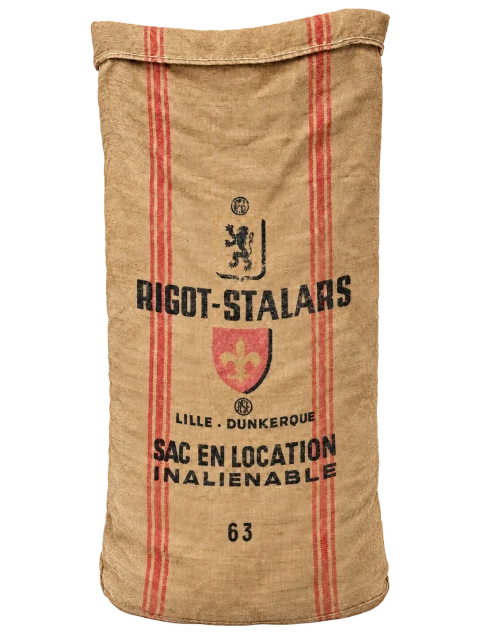
A sack's life does not end with its first delivery
For the firm, a sack is both merchandise and a tool. It must hold its contents, withstand transport, be closed, moved and sometimes put back into service. Early recovery work builds knowledge of its condition, strength and possible repairs. Buying a batch of used sacks already requires knowing what can be done with them.
Hiring out sacks extends this logic. The customer uses them for an operation; their value rests on their ability to circulate and serve again. The development of Dunkerque through the takeover of Meyer-Petitqueux gives this trade an important place. In Rouen, used sacks are still offered in the 1920s. Reuse is part of the firm's everyday economy.
Sort, repair, sew
Workshop photographs let us follow the material. Stacks wait against the walls; other sacks are spread across tables. Women stand or sit by the machines. Around them, cloth occupies almost as much space as the furniture. Preparation, sewing and storage share the same room.
In Dunkerque in 1929, the firm seeks women who can repair sacks by hand with a sailmaker's palm and by machine. These two methods remind us that mechanisation does not erase manual skill. Repairs must suit the sack's wear and the strength required. A seam, fold or mended area determines how the object can next be used.
From raw jute to cloth
The acquisition of the Marquette weaving mill in 1928 and the Fives spinning mill in 1933 broadens this expertise. The firm can now intervene earlier in manufacture. Spinning turns fibre into yarn; weaving produces cloth; sewing workshops make sacks and other articles.
This organisation brings the sold product closer to its manufacture. It also requires different trades, equipment and suitable premises. Alongside the demands of trading staff and repair teams come those of spinning and weaving. The company no longer merely handles sacks: it transforms the material from which they are made.
Working at the scale of a tarpaulin
Beneath the Dunkerque roof timbers, a large piece of cloth spreads across the floor. Men are positioned around it. The photograph immediately shows what making a tarpaulin requires: space to unfold the piece, room to move it and coordination between several people.
In La Madeleine, other pictures show long hanging cloths and stocks filling the bays. The variety of spaces matches the variety of uses. Sacks, tarpaulins, cloth and twine contain, cover, protect and fasten. When the company moves into plastics and packaging machines, it will encounter these same needs in new forms.
The rest of the story
A new era for packaging